


Key Points
- Simultaneously realized efficient energy-harvesting and emission of bright visible red light within a single device
- Elucidated an ideal energy structure by combining light-emitting molecules used in the OLED field
- Contribute to the development of multifunctional energy-harvesting displays, as well as the improvement of conversion efficiency in organic photovoltaics
Overview
A research team led by Associate Professor Seiichiro Izawa of the Materials & Structures Laboratory, Institute of Integrated Research, Institute of Science Tokyo, and Associate Professor Naoya Aizawa of the Institute for Chemical Reaction Design and Discovery (WPI-ICReDD), Hokkaido University, has successfully developed organic photovoltaics that combine energy-harvesting and light-emission functions.
While photovoltaic devices such as solar cells, and light-emitting devices such as LEDs and OLEDs are both diode devices, it is difficult to integrate energy-harvesting and light-emitting functions into a single device, and there are very few examples that have achieved both functions with high efficiency.
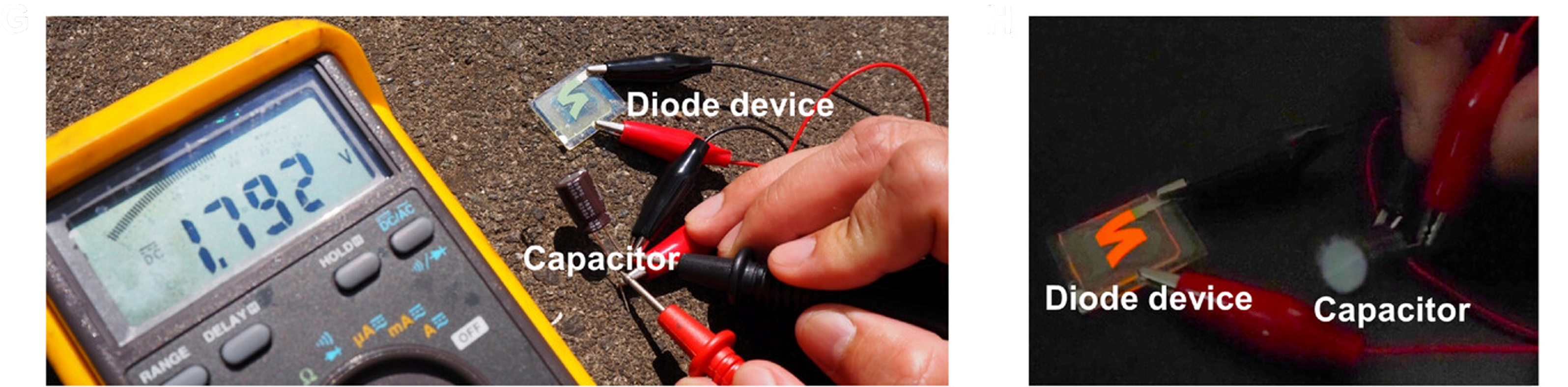
In this study, the research team succeeded in integrating both energy-harvesting and light-emitting functions within a single device by combining two types of emitters used in the OLED field. Specifically, by selecting appropriate molecules to create an ideal energy structure that suppresses transitions to the excited triplet state (where energy is lost as heat rather than light), they achieved efficient light emission at display-level brightness from the interface between the two materials. This device demonstrates high photovoltaic performance under sunlight illumination; it can charge a capacitor and also emit light using the stored energy. Furthermore, during the charging process with this device, a very high voltage value close to the theoretical limit was obtained.
These results are expected to contribute significantly to practical applications, such as enabling smartphone displays to function as energy-harvesting devices, as well as to improving the conversion efficiency of organic photovoltaics by introducing a similar ideal energy structure into them.
These findings were published in the April 20 issue of the journal Advanced Materials.
For details, please visit here (Research news article, Institute of Science Tokyo)