


Key Points
- Different reactivities of α-silyl organolithium and organosodium complexes bearing identical ligands.
- Structure-dependent reactions with CO and CO₂
- Detailed mechanistic analysis using ICReDD’s computational techniques.
Overview
An international research group including Wataru Kanna, Specially Appointed Assistant Professor, and Hiroki Hayashi, Specially Appointed Associate Professor at ICReDD (at the time of the research; currently Associate Professor at the Research Center for Materials Science, Nagoya University), Xiao Yang, a PhD candidate at the University of Birmingham; Associate Professor Erli Lu of the same university; and Dr. Jack Hemingway, a postdoctoral researcher at Newcastle University, have revealed that although α-silyl organolithium complexes and α-silyl organosodium complexes bind to the same ligands, they exhibit different reactivity due to the properties of their central metals.
α-Silyl organometallic complexes possesses unique reactivity and are widely used in organic synthesis. In particular, their diverse reactivity involving the cleavage of carbon-silicon bonds has attracted significant attention, and α-silyl organometallic complexes containing various metal species have been synthesized and utilized to date. However, α-silyl organometallic complexes with lithium or sodium as the central metal tend to aggregate, making it difficult to investigate the structures and reactivities of their monomeric species; therefore, detailed reactivity analyses remain elusive.
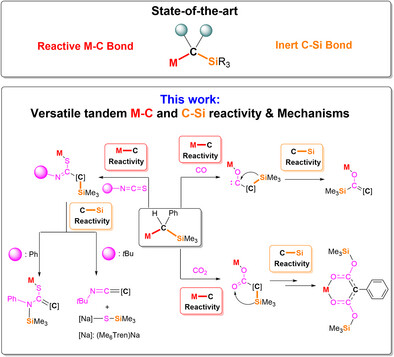
In this study, the research group examined the reactions between these monomers and CO, CO2, and heteroallenes (such as isocyanates and isothiocyanates) using mononuclear lithium- or sodium-containing α-silyl alkyl complexes that they have developed previously. As a result, the research group discovered that despite having the same ligands, the metal complexes afforded different products depending on the central metal. Analysis of computational results using the Artificial Force Induced Reaction (AFIR) method of ICReDD suggested that these differences in reactivity stem from structural differences in the complexes arising from the properties of the central metal. This study has offered new insights into the reactivity of alkali metal complexes and is expected to contribute significantly to the precise design of organic alkali metal complexes and the efficient synthesis of useful molecules in the future.
The results of this study were published in Angew. Chem., Int. Ed. on Saturday, April 11, 2026.