


—Unraveling the rate-limiting processes of mechanochemical synthesis through interdisciplinary research combining organic chemistry and soft matter physics—
Key Points
- Developed a reaction rate theory for mechanochemistry using ball milling.
- Predicts that the characteristic progression of mechanochemical synthesis is arising from the crossover between regimes of rate-limiting processes.
- Holds promise for application to the theory of designing mechanochemical synthesis reactions.
Overview
A research group led by Specially Appointed Associate Professor Tetsuya Yamamoto, Specially Appointed Professor Yu Harabuchi, and Associate Professor Julong Jiang from the Institute for Chemical Reaction Design and Discovery (WPI-ICReDD), Professor Koji Kubota and Professor Hajime Ito of WPI-ICReDD and the Faculty of Engineering at Hokkaido University, has developed a theory that predicts the rate-limiting process in mechanochemical organic synthesis using ball milling through interdisciplinary research combining organic chemistry and rheology.
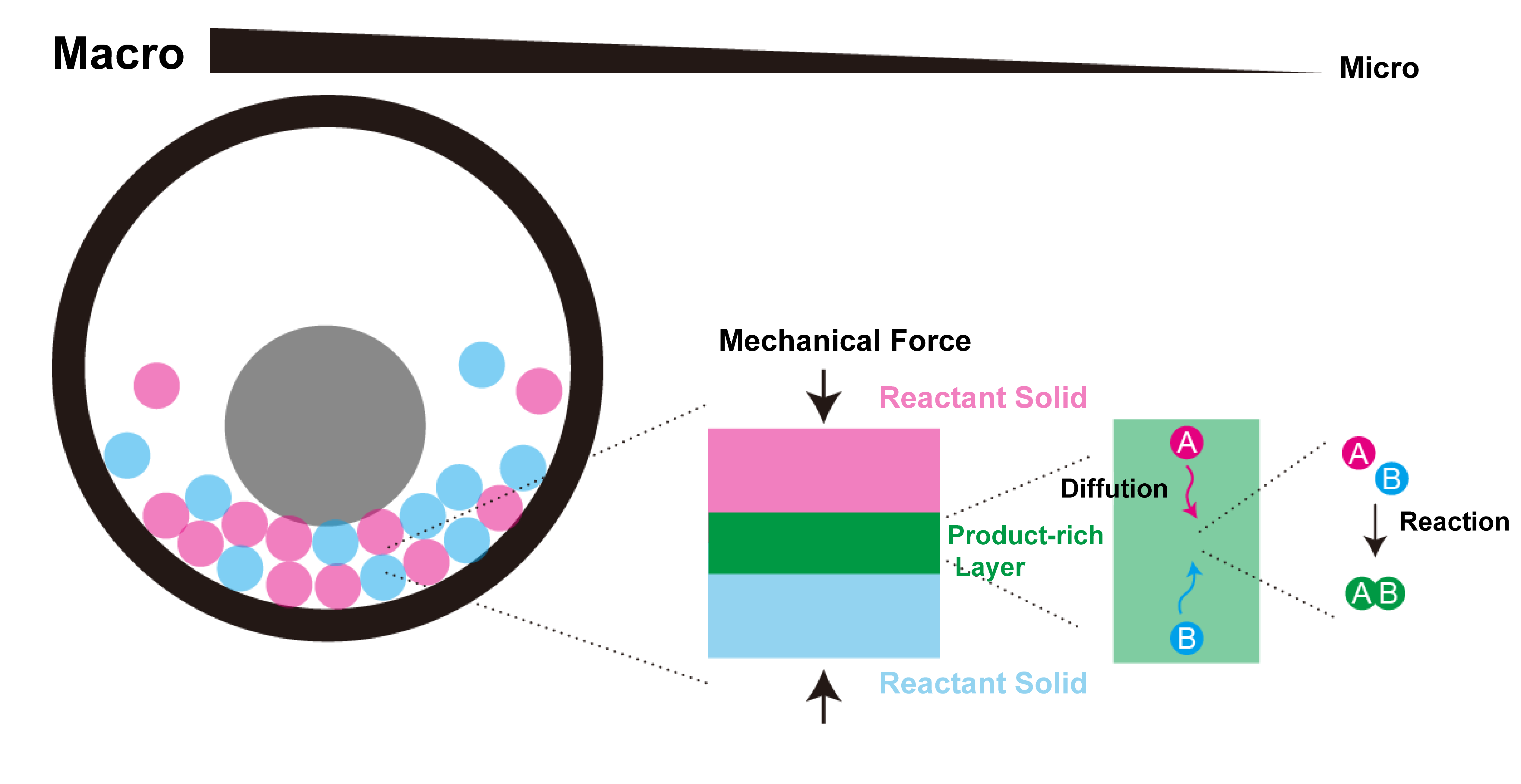
Unlike conventional organic synthesis in dilute solutions, mechanochemical organic synthesis using ball milling is attracting attention as an efficient synthetic method that does not require solvents. In dilute solutions, the reaction often slows down over time because the amount of reactants decreases as the reaction proceeds. On the other hand, when the same reaction is performed via mechanochemical synthesis, it has been experimentally observed that the reaction initially accelerates with time and then slows down as time passes. In this study, the research group developed a theoretical framework to analyze reaction rates by applying scaling theory—frequently used in soft matter physics—to mechanochemical reaction systems.
The rate of a mechanochemical reaction is determined by the balance between the reaction rate itself and the ease with which molecules diffuse into the product phase. In this synthetic method, the reaction often proceeds while the reactants remain in the solid state. Since the reaction between two solids occurs at their interface, a layer composed primarily of the product (the product-rich layer) forms, and its thickness increases as the product is generated through the reaction. We theoretically demonstrated that, because the reaction occurs mainly within the product-rich layer, the reaction accelerates in the early stages as the product-rich layer grows, whereas from the middle stages onward, the product-rich layer becomes too thick, making it difficult for reactants to encounter each other, causing the reaction to slow down. This research is expected to elucidate mechanochemical reactions from a physicochemical perspective and contribute to the development of design theories.
The results of this study were published online in the journal Chinese Physics B on Friday, April 10, 2026.