
Key Points
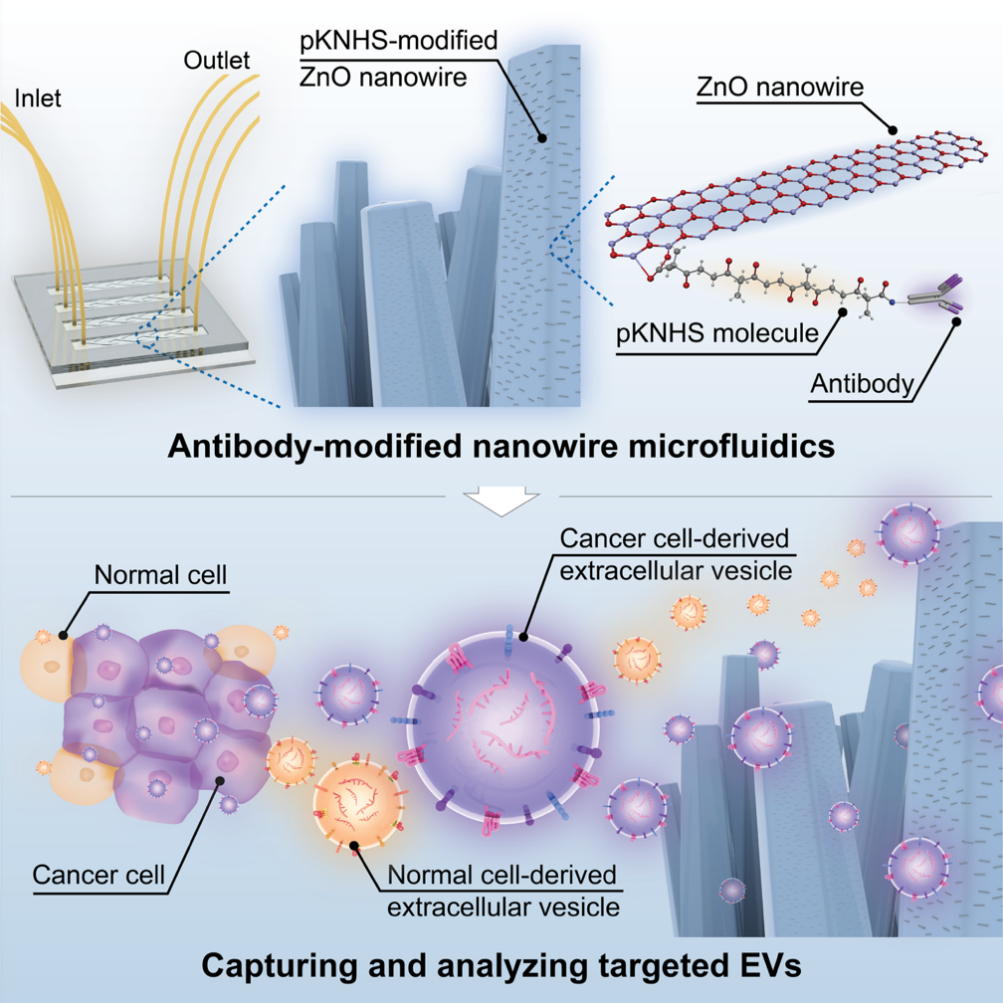
- Developed a method that enables a single-step conjugation of zinc oxide (ZnO) nanowires with antibodies using discrete, chain-engineered polyketones.
- Polyketone-modified ZnO nanowires can efficiently capture cancer-associated extracellular vesicles while suppressing the adsorption of non-specific proteins.
- Different subpopulations of EVs with distinct surface markers were selectively isolated from the serum of ovarian cancer patients, and distinct microRNA expression profiles were identified for each subpopulation.
Overview
Professor Takao Yasui and Designated Assistant Professor Kunanon Chattrairat of the Graduate School of Engineering at Nagoya University, along with Professor Yasuhide Inokuma of the Graduate School of Engineering at Hokkaido University, in collaboration with research groups from Institute of Science Tokyo, Kyoto University, and the National Institute for Quantum Science and Technology, have developed a new microfluidic platform that utilizes dicrete polyketones with precisely controlled chain lengths, to functionalize the surface of ZnO nanowires, enabling the selective isolation and analysis of disease-associated extracellular vesicles (EVs) present in only minute quantities in serum. Furthermore, by applying this technology to the serum of ovarian cancer patients, they successfully detected different microRNA distributions for each EV surface marker.
This research is expected to advance liquid biopsy from a method that broadly examines all EVs in the blood to one that specifically targets and analyzes disease-related EV subpopulations. In the future, this could lead to the early detection of cancer and more accurate non-invasive diagnosis.
The results of this study were published in the online edition of the Cell Press journal Device on May 19, 2026.