


~A novel molecular foundation for the evolution of SARS-CoV-2 pathogenicity~
Points
- A multiscale analysis of the virological properties of SARS-CoV-2 Omicron XEC variant.
- The nucleocapsid R204P mutation of XEC was found to enhance pathogenicity.
- Important insights for predicting the future evolution of the SARS-CoV-2 and assessing its pathogenicity.
Overview
A research group including Professor Takasuke Fukuhara, Associate Professor Tomokazu Tamura, and Assistant Professor Shuhei Tsujino of the Faculty of Medical Sciences at Kyushu University, Hokkaido University, the Medical Research Laboratory, Institute of Integrated Research, Institute of Science Tokyo, the Institute of Medical Science at the University of Tokyo, and The Genotype to Phenotype Japan (G2P-Japan) research consortium conducted a comprehensive multiscale investigation to elucidate the virological properties of the SARS-CoV-2 XEC variant and revealed that mutations in the nucleocapsid protein contribute to its enhanced pathogenicity.
The XEC variant emerged around August 2024 through recombination of two Omicron JN.1 descendants, and became predominant through early 2025. The XEC has been reported to exhibit a higher effective reproduction number than previous epidemic strains, and has been classified as a “variant under monitoring (VUM)” by the World Health Organization (WHO). However, their virological characteristics and the mutations that define them remained unclear.
In this study, the research group first demonstrated that mutations in the spike protein are primarily responsible for the rapid spread of XEC using mathematical models. Furthermore, a comparison of XEC with their ancestral JN.1 revealed that while there were no significant differences in their antiviral susceptibility or their proliferation ability in cultured cells and organoids, the XEC exhibited higher pathogenicity than JN.1 in a hamster model.
To elucidate the factors behind this enhanced pathogenicity, the research group performed analyses using recombinant viruses with point mutations and identified the R204P mutation in the nucleocapsid protein as being involved in pathogenicity. Furthermore, structural prediction and molecular biological analysis revealed that this mutation contributes to enhanced pathogenicity by promoting the inflammatory response via the NF-κB pathway. These results demonstrate the importance of focusing on the role of not only spike proteins but also non-spike proteins in understanding the evolution and pathogenicity of SARS-CoV-2. These findings are expected to contribute to predicting the evolution of mutant strains and assessing their pathogenicity.
The results of this research were published in the international academic journal Nature Communications on Sunday, December 14, 2025.
DOI: 10.1038/s41467-025-67455-4
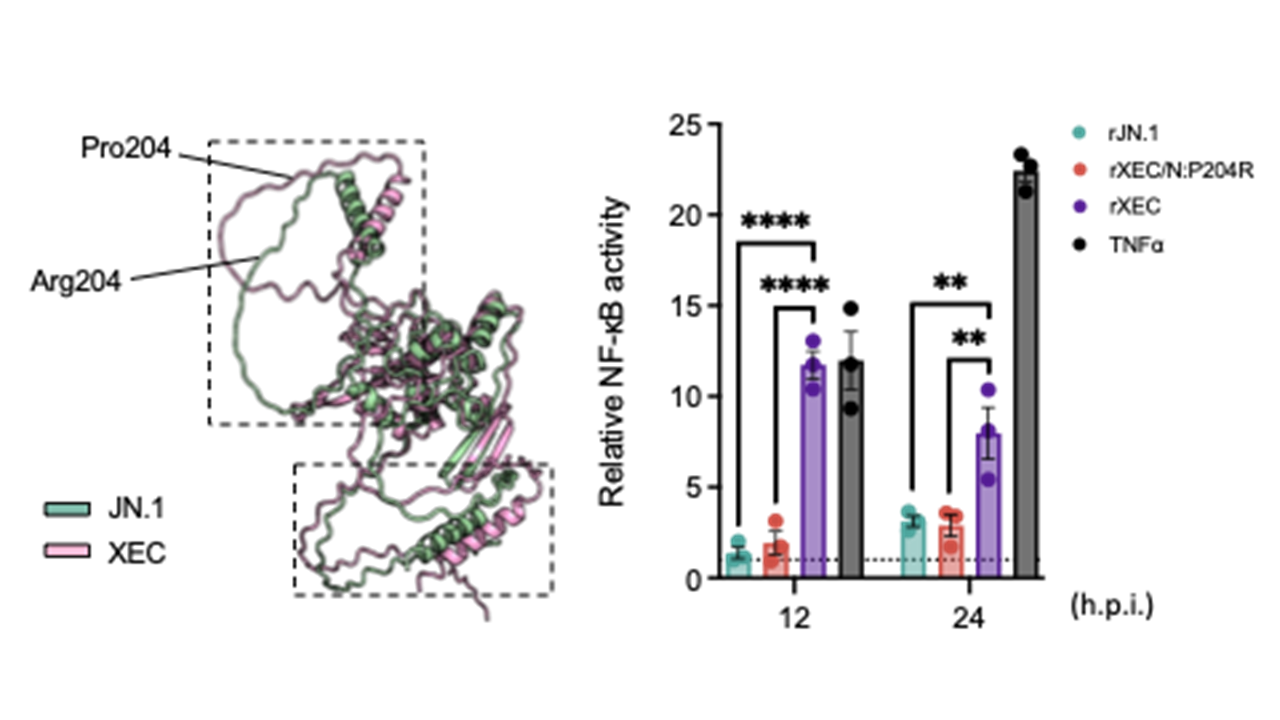
The nucleocapsid R204P mutation in SARS-CoV-2 Omicron XEC contributes to NF-κB activation along with a structural change.