


Scientists use light-driven chemistry to synthesize a valuable pharmaceutical building block and generate trifluoromethyl radicals directly from inexpensive, low-toxicity fluoroform.

The trifluoromethyl group, or CF₃, is widely used in pharmaceuticals. When added to organic molecules, it can improve metabolic stability and membrane permeability, making it highly valuable in drug development.
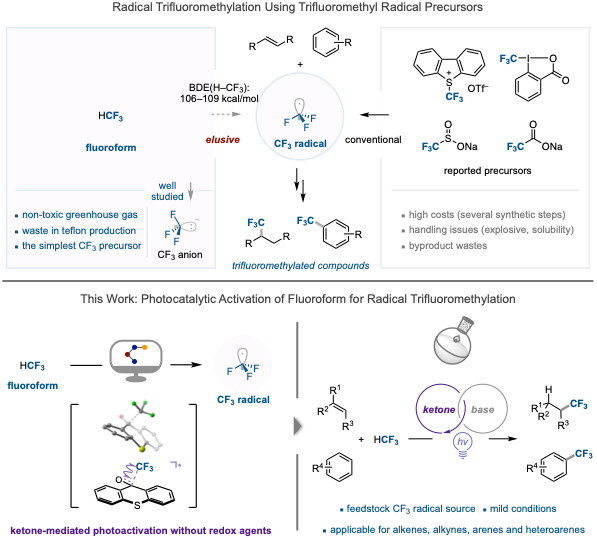
One useful way to introduce CF₃ group is through the use of highly reactive CF₃ radicals. However, existing methods for generating these radicals often rely on expensive, corrosive, or potentially explosive reagents and can produce unwanted waste.
Researchers at Hokkaido University have now developed a new method to generate CF₃ radicals directly from fluoroform, an inexpensive gas with relatively low toxicity to humans that is produced as a byproduct of Teflon manufacturing. The method uses light energy, a ketone catalyst, and a base to activate fluoroform under relatively mild conditions. The findings were published in the Journal of the American Chemical Society.
Fluoroform is inexpensive and readily available. It is also a potent greenhouse gas, with a global warming potential about 15,000 times that of carbon dioxide, making its conversion into useful chemicals particularly attractive.
Directly generating CF₃ radicals from fluoroform has remained difficult because its strong carbon-hydrogen bond resists cleavage under mild conditions. To overcome this, the researchers used the Artificial Force Induced Reaction (AFIR) method, a computational technique developed at Hokkaido University’s WPI-ICReDD, to search for an alternative activation pathway. Their calculations suggested that a thioxanthone-derived alkoxide intermediate could release a CF₃ radical when excited by light. Experiments subsequently supported this prediction.
“Fluoroform is an attractive source of trifluoromethyl groups, but its chemical stability has made it difficult to use directly as a radical source,” says Kosaku Tanaka III, co-author of the study. “By combining computational chemistry with experiments, we found a new way to activate it using light.”
The researchers successfully used the method to add CF₃ group to a broad range of molecules, including alkenes, alkynes, and aromatic compounds. They also introduced CF₃ groups into complex bioactive molecules and their derivatives, demonstrating the method’s potential for late-stage modification of compounds relevant to drug discovery.
In another demonstration, the team combined fluoroform with inexpensive methyl methacrylate to produce a high-value compound used as an intermediate in pharmaceutical synthesis. The reaction achieved a yield of about 65 percent, while nearly all of the ketone catalyst could be recovered for reuse.
The method could provide a new route to fluorinated pharmaceuticals and functional materials while transforming an underused industrial byproduct into a valuable resource for chemical synthesis.
Original article:
Zhou et al., Photocatalytic Activation of Fluoroform for Radical Trifluoromethylation. Journal of the American Chemical Society. 4 August 2026.
DOI: 10.1021/jacs.6c10939
See the press release for details (Hokkaido University’s website)